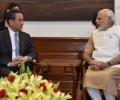
Wang and Swaraj also discussed issues relating to annual BRICS summit which will be hosted by India in Goa in October.

As part of a new rotation policy of paramilitary forces' squads at the Republic Day parade, the contingents of two other forces -- the Central Reserve Police Force and Central Industrial Security Force -- have been taken out of the event this time, officials said.

We have seen great strides in all-around cooperation, Chinese foreign ministry spokesperson said.

The United States House of Representatives on Friday postponed the formal vote on the approval legislation for the India-US civilian nuclear agreement, following a 40-minute debate.House Foreign Affairs Committee Chairman Howard Berman, a known opponent of the deal, supported the Senate version of the Bill saying the deal is a positive step as it will bring India into the non-proliferation regime.Fellow Democrat Edward Markey demanded a recorded vote.
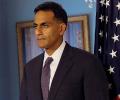
Verma, 46, is the first Indian-American to be the US ambassador to India and is expected to be sworn in shortly.

If China would not have extended the technical hold, Azhar would have automatically been designated under the UN as a terrorist.
Against the backdrop of Beijing's negative role at the Nuclear Suppliers Group meeting in Vienna, Chinese Foreign Minister Yang Jeichi on Monday met Prime Minister Manmohan Singh and held talks with External Affairs Minister Pranab Mukherjee. Dr Singh told Yang that India was pleased to get the NSG waiver last week, official sources said.
'The Bush administration, through a gag order on its written responses to Congressional questions, had sought to keep the Indian public in the dark on the larger implications of the nuclear deal, lest the accord run into rougher weather. But now its 26 pages of written answers have been publicly released by a senior United States Congressman.'

India is expected to strongly push for a bilateral totalisation agreement with the US during President Barack Obama's visit later this month.

India, China and other countries that have been cutting their oil imports from Iran have reached a point where it is "very very difficult" to reduce any further without seriously impacting their economies, US Secretary of State John Kerry has told lawmakers.
The United Progressive Alliance government on Thursday expressed hope that India will get the support of all member countries during its negotiations on the nuclear deal but noted that it would be difficult to fix an exact timeframe for making the agreement a reality.External Affairs Minister Pranab Mukherjee said the Board of Governors of the International Atomic Energy Agency is likely to meet on August 1 to discuss the India-specific safeguards agreement.
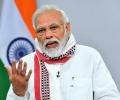
The military brass is learnt to have apprised Modi about the evolving situation in eastern Ladakh, though officials maintained that the agenda of the pre-scheduled meeting was to discuss the ambitious military reforms and ways to boost India's combat prowess.

"We are committed to building a new India. We have to do this as early as possible," he said.
During the meeting, held at the residence of Pranab Mukherjee, the government's pointsman for the deal, Samajwadi Party leader Amar Singh was understood to have been briefed about the deal and the steps India would have to take in the coming weeks to push it through.
Downer will ask the Cabinet to approve the export of Australian uranium to India in a submission to be considered by the government within weeks, The Australian newspaper reported on Thursday.
External Affairs Minister Pranab Mukherjee rejected suggestions that the United Progressive Alliance government's capacity to operationalise the deal has weakened after the Congress' debacle in Gujarat and Himachal Pradesh assembly elections. "We would not like to proceed with the deal if the Left parties withdraw support from the government," he told Karan Thapar's India Tonight programme on CNBC.
Wednesday's critical United Progressive Alliance-Left meeting on the Indo-US nuclear deal ended with both sides agreeing to meet again soon. The date for the same is yet to be finalised
Communist Party of India Marxist General Secretary Prakash Karat on Wednesday met External Affairs Minister Pranab Mukherjee in an effort to break the logjam over the India-United States nuclear agreement.Karat went to Mukherjee's residence early in the morning to hold discussions on the issue that has created a stand-off between the government and the Left allies.The meeting assumes significance as it comes hours ahead of the crucial UPA-Left committee meeting.
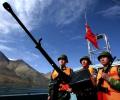
The Chinese side has particularly bolstered its presence in the Galwan Valley, erecting around 100 tents in the last two weeks and bringing in heavy equipment for construction of bunkers, notwithstanding the stiff protest by Indian troops. There have been reports of multiple incidents of transgressions by Chinese troops in several areas in Eastern Ladakh.
Prime Minister Manmohan Singh continues to be unwell, External Affairs Minister Pranab Mukherjee has postponed his visit to Australia by a day and Communist Party of India-Marxist General Secretary Prakash Karat has warned that the Left will withdraw support to the United Progressive Alliance government by Wednesday if the UPA continues to pursue the India-US nuclear deal.
During the nearly two-hour meeting that lasted almost till midnight at 10 Janpath, Mukherjee, the government's pointsman on the deal with United Progressive Alliance allies and the Left parties, and Antony apprised Sonia of the talks they had with leaders of the constituents of the ruling alliance and the Communist Party of India-Marxist and CPI in the last two days. Emerging from the meeting, neither Mukherjee nor Antony spoke to the media.

Asserting that the Indian security forces have exercised highest degree of restrain in Jammu and Kashmir after August 5, the external affairs minister told a Washington audience that he expects Pakistan to continue what it has been doing for the past several decades.

'The Indian strategy is to rope in the powerful Pakistan army in the negotiating spectrum. This can be done at the level of General Janjua, a former army commander,' reveals Rajeev Sharma.

To curb rising food prices, the Union government is contemplating using large-scale nuclear irradiation technologyfor increasing the shelf life of fruit and vegetables, particularly that of onions and potatoes.

India and China have agreed to maintain peace and tranquillity in the border areas which was a "pre-requisite" for continued growth of bilateral relations as also to enhance cooperation in key areas, including counter-terrorism, maritime security and civil nuclear energy sector.

'Alas, the Congress party offers no suggestions as to how to unscramble the omlette it cooked during 2004-2014 on which the Modi government may have since lavishly spread some tomato ketchup,' says Ambassador M K Bhadrakumar.
The meeting of UPA-Left Committee on nuclear issue, scheduled for Wednesday, has been postponed, putting back further a decision on whether India should sign the safeguards agreement with IAEA. The meeting is now expected in the first half of next month.
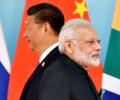
'The events of 2020 have actually put our relationship under exceptional stress.' What External Affairs Minister Dr Subrahmanyam Jaishankar told the All India Conference of China Studies on Thursday, January 28, 2021.

With Shanghai Cooperation Organisation set to admit India and Pakistan amid growing rancour over their Nuclear Supplies Group membership bid, a Chinese state-run daily expressed concern on Friday that the hostility between them may have a "negative effect" on the security grouping.

The minister said the terrorist groups created by Pakistan is not only harming India, but also hurting its neighbours.
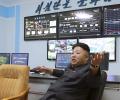
The External Affairs Ministry on Thursday discarded the article titled 'India's embarrassing North Korean connection' by Nilanjana Bhowmick in Al Jazeera, a Doha-based broadcaster, saying the insinuation regarding New Delhi's assistance to North Korea in United Nations proscribed activities is 'baseless and without any merit.'
Dr Anil Kakodkar, chairman of India's Atomic Energy Commission and his agency was the 600-pound gorilla in the room that vetoed the compromise language on the stalled bilateral civilian nuclear cooperation accord, known as the 123 Agreement.

US Secretary of State Condoleezza Rice arrived in Delhi on Saturday on a day-long visit, but the 123 agreement will not be signed during her stay here. Rice will meet Prime Minister Manmohan Singh and hold talks with External Affairs Minister Pranab Mukherjee on a wide range of issues, including the civil nuclear initiative.
Highlighting the mockery of proliferation controls made by the network of Pakistani nuclear scientist A Q Khan, India on Wednesday warned that weapons of mass destruction (WMD) could fall into the hands of terrorists and sought a "new approach" to address the critical challenge.
Congress party's chief spokesperson Abhishek Singhvi has met Pentagon officials in an apparent exercise to apprise the United States leadership about the status of the stalled Indo-US civilian nuclear agreement. Singhvi is also due to address the World Affairs Council and The Heritage Foundation, the United States India Business Alliance said, while praising the Congress for sending a 'legal expert' like Singhvi.

Juster, who is the Deputy Assistant to the US president for International Economic Affairs and Deputy Director of his National Economic Council, would replace Richard Verma if nominated and confirmed by the Senate.
The lawmaker, who was among the authors of the enabling legislation -- called the Hyde Act -- to facilitate the nuclear agreement, said: "The ball is back in your (India's) court. To those who would try to bully from a minority position, to tell the majority of people what is in their national interests and that if they do not do as that group says, that they are being bullied, are themselves the bullies."
A day after All India Congress Committee President Sonia Gandhi strongly defended the nuclear deal with the United States, Union Minister of State for Home Affairs Sriprakash Jaiswal said that there was no going back on the 123 Agreement. He added that if necessary, the Congress was ready to sacrifice the United Progressive Allaince government. He defended the UPA government's decision to enter into an agreement with Washington.
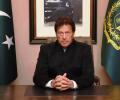
Khan said time has come to begin a 'comprehensive dialogue' between the two countries.
